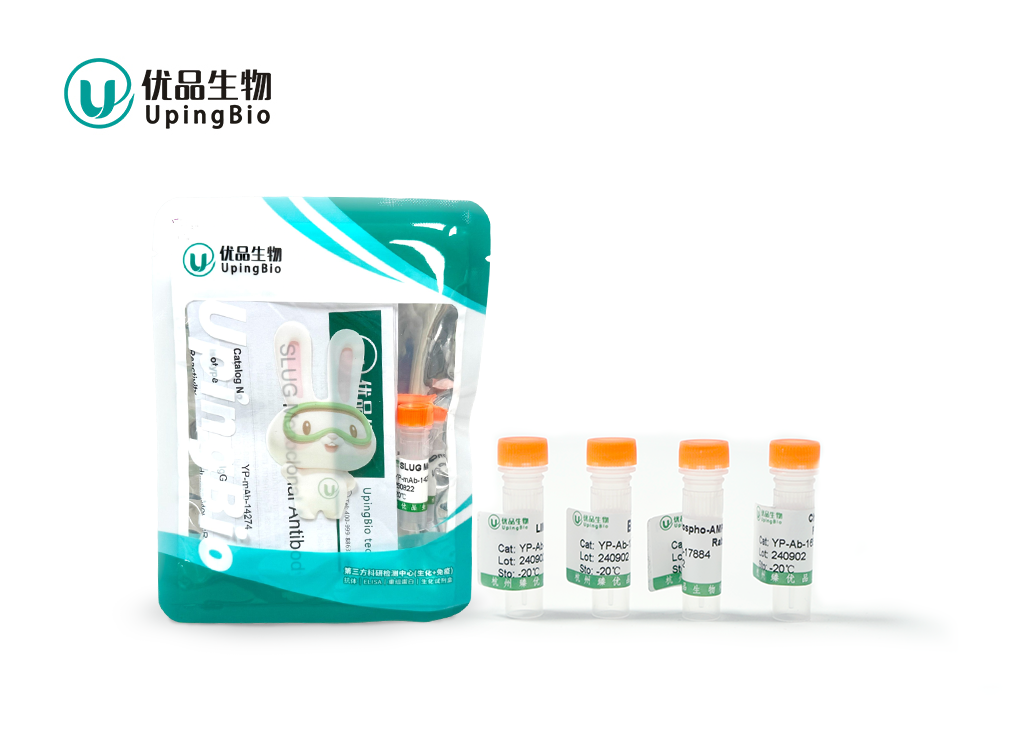
基因名称(Gene Name)
CHUK/IKBKB
蛋白名称
Inhibitor of nuclear factor kappa-B kinase subunit alpha
特异性
IKK-α/β (Phospho Ser176/180) antibody detects endogenous levels of IKKα/β only when phosphorylated at S176/S180.The name of modified sites may be influenced by many factors, such as species (the modified site was not originally found in human samples) and the change of protein sequence (the previous protein sequence is incomplete, and the protein sequence may be prolonged with the development of protein sequencing technology). When naming, we will use the "numbers" in historical reference to keep the sites consistent with the reports. The antibody binds to the following modification sequence (lowercase letters are modification sites):QGsLC/CTsFV
组成
PBS, 50% glycerol, 0.05% Proclin 300, 0.05%BSA
来源
Monoclonal, Rabbit,IgG
稀释比例
IHC 1:200-1:1000; WB 1:1000-1:5000; IF 1:200-1:1000; ELISA 1:5000-1:20000; Note: For IHC, we suggest antigen retrieval with TE buffer pH 9.0
储存
-15°C to -25°C/1 year(Do not lower than -25°C)
其他名称
IKKα/β Phospho Ser176/Ser180;Inhibitor of nuclear factor kappa-B kinase subunit alpha;CHUK ; IKKA ; TCF16 ; Inhibitor of nuclear factor kappa-B kinase subunit alpha ; I-kappa-B kinase alpha ; IKK-A ; IKK-alpha ; IkBKA ; IkappaB kinase ; Conserved helix-loop-helix ubiquitous kinase ; I-kappa-B kinase 1 ; IKK1 ; Nuclear factor NF-kappa-B;CHUK/IKBKB
背景
This gene encodes a member of the serine/threonine protein kinase family. The encoded protein, a component of a cytokine-activated protein complex that is an inhibitor of the essential transcription factor NF-kappa-B complex, phosphorylates sites that trigger the degradation of the inhibitor via the ubiquination pathway, thereby activating the transcription factor. [provided by RefSeq, Jul 2008],
功能
Catalytic activity:ATP + [I-kappa-B protein] = ADP + [I-kappa-B phosphoprotein].,enzyme regulation:Activated when phosphorylated and inactivated when dephosphorylated.,Function:Acts as part of the IKK complex in the conventional pathway of NF-kappa-B activation and phosphorylates inhibitors of NF-kappa-B thus leading to the dissociation of the inhibitor/NF-kappa-B complex and ultimately the degradation of the inhibitor. As part of the non-canonical pathway of NF-kappa-B activation, the MAP3K14-activated CHUK/IKKA homodimer phosphorylates NFKB2/p100 associated with RelB, inducing its proteolytic processing to NFKB2/p52 and the formation of NF-kappa-B RelB-p52 complexes. Also phosphorylates NCOA3. Phosphorylates 'Ser-10' of histone H3 at NF-kappa-B-regulated promoters during inflammatory responses triggered by cytokines.,PTM:Phosphorylated by MAP3K14/NIK, AKT and to a lesser extent by MEKK1, and dephosphorylated by PP2A. Autophosphorylated.,similarity:Belongs to the protein kinase superfamily.,similarity:Belongs to the protein kinase superfamily. Ser/Thr protein kinase family. I-kappa-B kinase subfamily.,similarity:Contains 1 protein kinase domain.,subcellular location:Shuttles between the cytoplasm and the nucleus.,subunit:Component of the I-kappa-B-kinase (IKK) core complex consisting of CHUK, IKBKB and IKBKG; probably four alpha/CHUK-beta/IKBKB dimers are associated with four gamma/IKBKG subunits. The IKK core complex seems to associate with regulatory or adapter proteins to form a IKK-signalosome holo-complex. Part of a complex composed of NCOA2, NCOA3, CHUK/IKKA, IKBKB, IKBKG and CREBBP. Part of a 70-90 kDa complex at least consisting of CHUK/IKKA, IKBKB, NFKBIA, RELA, IKBKAP and MAP3K14. Directly interacts with IKK-gamma/NEMO and TRPC4AP (By similarity). May interact with TRAF2. Interacts with NALP2. May interact with MAVS/IPS1.,tissue specificity:Widely expressed.,