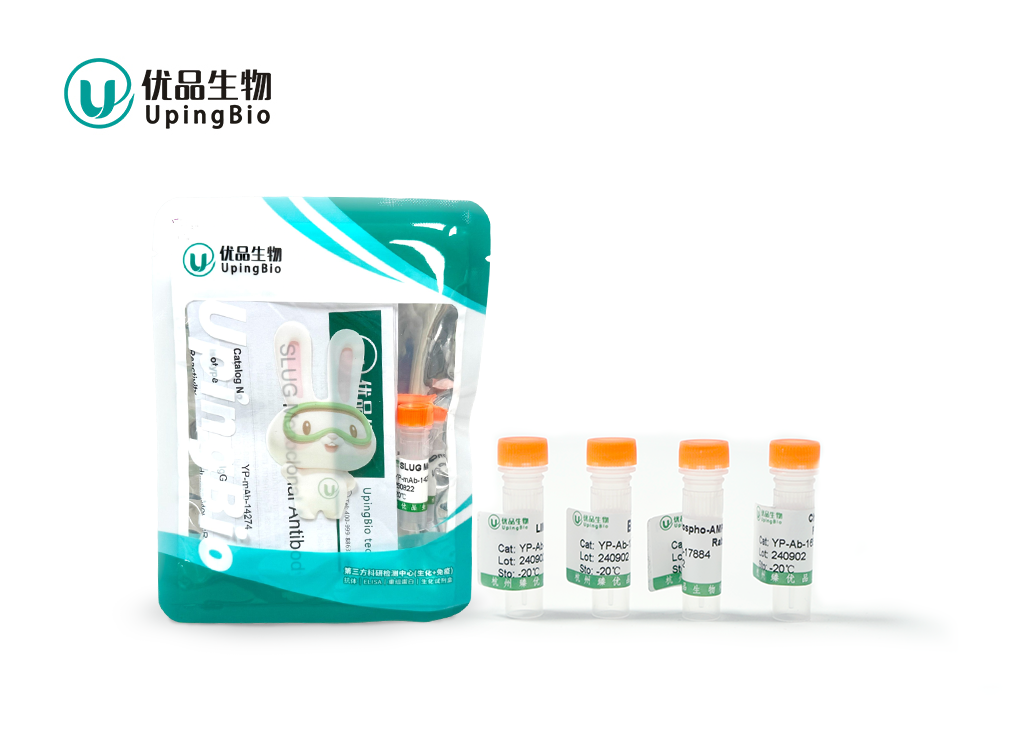
蛋白名称
cAMP-dependent protein kinase catalytic subunit alpha
组成
PBS, 50% glycerol, 0.05% Proclin 300, 0.05%BSA
来源
Monoclonal, Rabbit,IgG
稀释比例
IHC 1:2000-1:10000; WB 1:1000-1:5000; IF 1:200-1:1000; ELISA 1:5000-1:20000; IP 1:50-1:200; Note: For IHC, we suggest antigen retrieval with TE buffer pH 9.0
储存
-15°C to -25°C/1 year(Do not lower than -25°C)
其他名称
PRKACA ; PKACA ; cAMP-dependent protein kinase catalytic subunit alpha ; PKA C-alpha
背景
This gene encodes one of the catalytic subunits of protein kinase A, which exists as a tetrameric holoenzyme with two regulatory subunits and two catalytic subunits, in its inactive form. cAMP causes the dissociation of the inactive holoenzyme into a dimer of regulatory subunits bound to four cAMP and two free monomeric catalytic subunits. Four different regulatory subunits and three catalytic subunits have been identified in humans. cAMP-dependent phosphorylation of proteins by protein kinase A is important to many cellular processes, including differentiation, proliferation, and apoptosis. Constitutive activation of this gene caused either by somatic mutations, or genomic duplications of regions that include this gene, have been associated with hyperplasias and adenomas of the adrenal cortex and are linked to corticotropin-independent Cushing's syndrome. Altern
功能
Catalytic activity:ATP + a protein = ADP + a phosphoprotein.,enzyme regulation:Activated by cAMP.,Function:Phosphorylates a large number of substrates in the cytoplasm and the nucleus.,PTM:Asn-3 is partially deaminated to Asp giving rise to 2 major isoelectric variants, called CB and CA respectively.,similarity:Belongs to the protein kinase superfamily.,similarity:Belongs to the protein kinase superfamily. AGC Ser/Thr protein kinase family. cAMP subfamily.,similarity:Contains 1 AGC-kinase C-terminal domain.,similarity:Contains 1 protein kinase domain.,subcellular location:Translocates into the nucleus (monomeric catalytic subunit) (By similarity). The inactive holoenzyme is found in the cytoplasm.,subunit:A number of inactive tetrameric holoenzymes are produced by the combination of homo- or heterodimers of the different regulatory subunits associated with two catalytic subunits. cAMP causes the dissociation of the inactive holoenzyme into a dimer of regulatory subunits bound to four cAMP and two free monomeric catalytic subunits.,tissue specificity:Isoform 2 is sperm specific.,